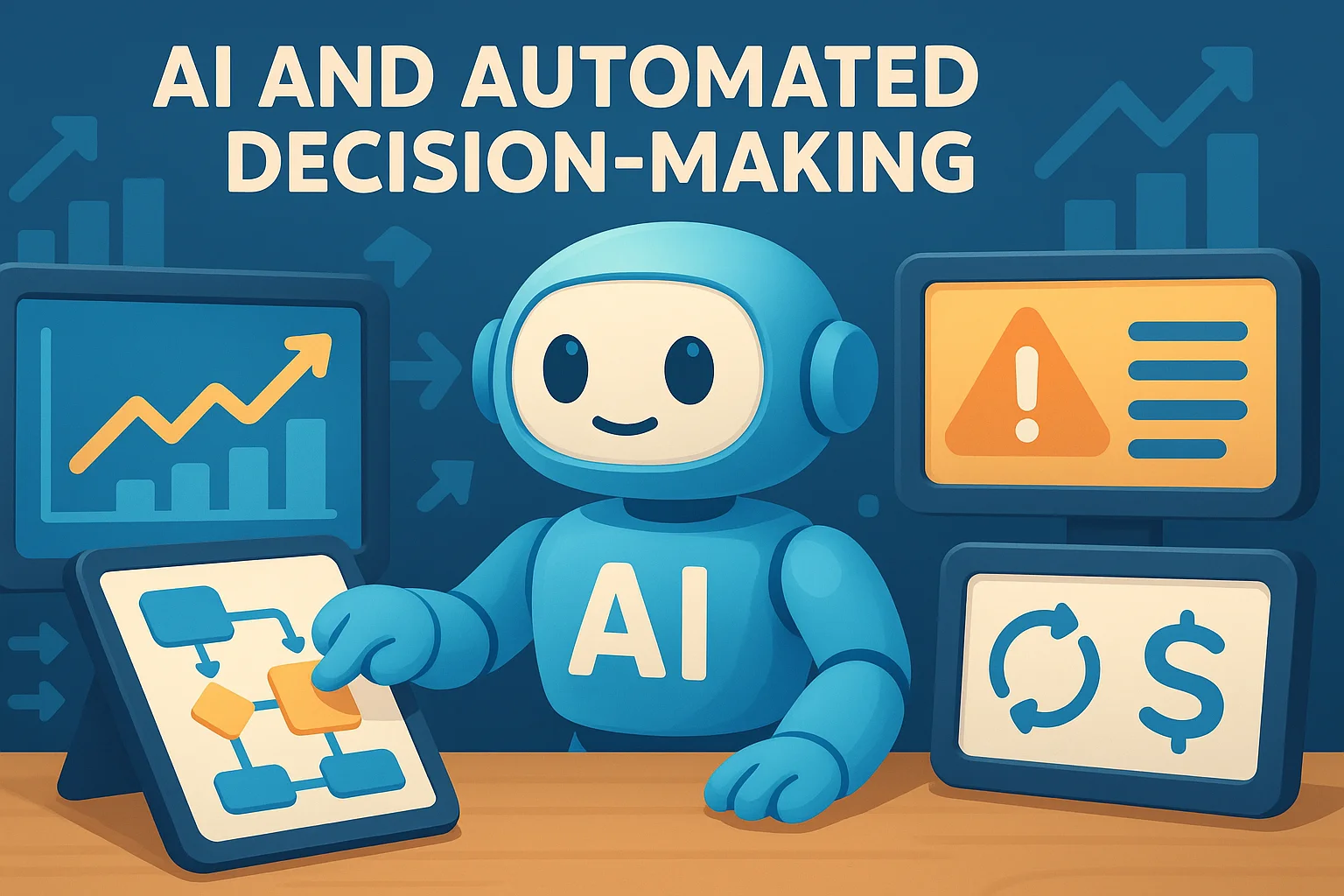
AI and Automated Decision-Making: Faster, Smarter, Scalable
From supply chains to finance desks, decision-making has historically been the bottleneck of scale. In 2026, that’s no longer the case. Thanks to artificial intelligence, companies now make hundreds of micro-decisions every second—automatically, intelligently, and with full context.
AI isn’t just about crunching data. It’s about acting on that data at scale. It empowers systems to trigger changes, respond to anomalies, and adjust strategies in real time, without waiting for human approval.
What Is AI-Powered Decision Automation?
AI decision automation involves using algorithms to make rule-based or predictive decisions based on real-time data. These systems can:
- Detect anomalies or patterns
- Trigger workflows or changes automatically
- Learn from results to refine future decisions
- Incorporate unstructured data (text, video, sentiment)
It’s not about removing people from the loop—it’s about putting AI in charge where scale, speed, or complexity demand it.
Where It’s Being Used Today
| Application Area | Example Use Case |
| ⚡ Real-Time Data Analysis | Automated dashboards adapting to streaming metrics |
| 💸 Dynamic Pricing | AI adjusts prices based on demand, seasonality, and competitors |
| 🎧 Customer Support Routing | Queries routed based on language, urgency, and emotion |
| 🕵️♂️ Fraud Detection | Behavioral biometrics and transaction patterns flag threats |
| 📦 Inventory Optimization | AI forecasts restock needs based on usage and trends |
| 📊 Portfolio Management | Automated trades based on news, macro indicators, and investor rules |
Benefits of Automated Decision-Making
| Benefit | Impact |
| 🚀 Faster Execution | Reduces latency from insight to action |
| 💡 Increased Precision | Decisions backed by data, not guesswork |
| 🔁 Continuous Learning | Models improve with each cycle |
| 🔒 Lower Risk | Real-time anomaly detection improves control |
| ⚖️ Scalable Governance | Transparent rules can be audited and traced |
Risks and Considerations
- False Positives: AI sometimes flags normal behavior as suspicious
- Lack of Explainability: “Why was this decision made?” must be traceable
- Bias Propagation: If trained on biased data, decisions will be biased too
- Over-automation: Removing humans entirely can be dangerous in critical contexts
- Regulatory Oversight: AI-driven decisions must be compliant and accountable
Future of Autonomous Business Operations
- 🤝 Human-AI Co-Decision Panels: Where both AI and human vote on critical events
- 🔍 Explainable AI (XAI): Every automated decision will come with a rationale
- 🧭 Ethics Layers: AI will follow not only logic but corporate values
- 🧬 Self-optimizing systems: AI updates the decision model based on outcome patterns
- 📡 Federated Learning: Shared decision models across partner organizations without data leakage
Conclusion
AI has already proven itself as a decision-maker—fast, informed, and tireless. But the future lies in orchestration, not just automation.Companies that embrace AI-powered decision-making don’t just move faster — they act smarter, reduce risk, and unlock exponential scale. The question is no longer if you should automate decisions, but which ones — and how soon.