AI in Workflow Automation: Streamlining Operations at Scale
In an age where speed, accuracy, and efficiency define business success, AI-powered workflow automation has become more than a competitive edge — it’s a strategic necessity. While traditional automation helped eliminate repetitive tasks, artificial intelligence goes several steps further: it learns, adapts, and optimizes processes in real time.
Whether you’re managing a digital agency, a global supply chain, or a customer support operation, AI can improve not just how things get done — but what gets done, when, and why.
According to Harvard Business Review, organizations that deploy AI-driven workflow automation report a 40–60% increase in process efficiency and a 30% reduction in operational overhead within 12 months.
What Exactly Is AI Workflow Automation?
AI workflow automation is the use of machine learning, natural language processing, and predictive analytics to automate tasks, decision paths, and resource management within business processes.
Unlike hard-coded rules, AI uses real-time data and historical patterns to decide:
- Which task should run next
- Who should handle a task
- How to escalate or reroute work
- When to trigger follow-ups
- Where bottlenecks or inefficiencies are forming
Expanded Use Cases in Real Organizations
| Sector | AI Workflow Use Case |
| 🏥 Healthcare | AI manages patient intake, assigns staff, schedules follow-ups |
| 🏢 Enterprise | Slack bots prioritize and assign incoming support tickets |
| 🧾 Finance | AI reconciles transactions, flags anomalies, and generates audit logs |
| 📦 Logistics | Smart routing optimizes delivery paths based on traffic & volume |
| 🎓 Education | Course scheduling AI balances faculty load and student preferences |
Top Tools Empowering AI Workflows (2025)
- Zapier + OpenAI — NLP-based trigger automation
- UiPath — Robotic process automation with AI routing
- Workato — Integration of AI with CRMs and marketing platforms
- Jasper Workflows — Content workflow builder powered by GPT agents
- Notion AI — Project notes auto-summarization and task creation
AI as a Digital Orchestrator: What It Actually Does
Let’s look at an example:
Scenario: A company receives 100+ daily support emails.
Traditional system: Sends to human agents → delays → inconsistent responses.
AI-driven system:
- Classifies each email by intent and sentiment
- Responds to FAQs autonomously
- Flags urgent issues for humans with suggested answers
- Updates ticket system, CRM, and sends satisfaction surveys
- Learns from each interaction to improve future responses
Result: Response time drops from 18 hours to 2 minutes, and agent workload drops by 40%.
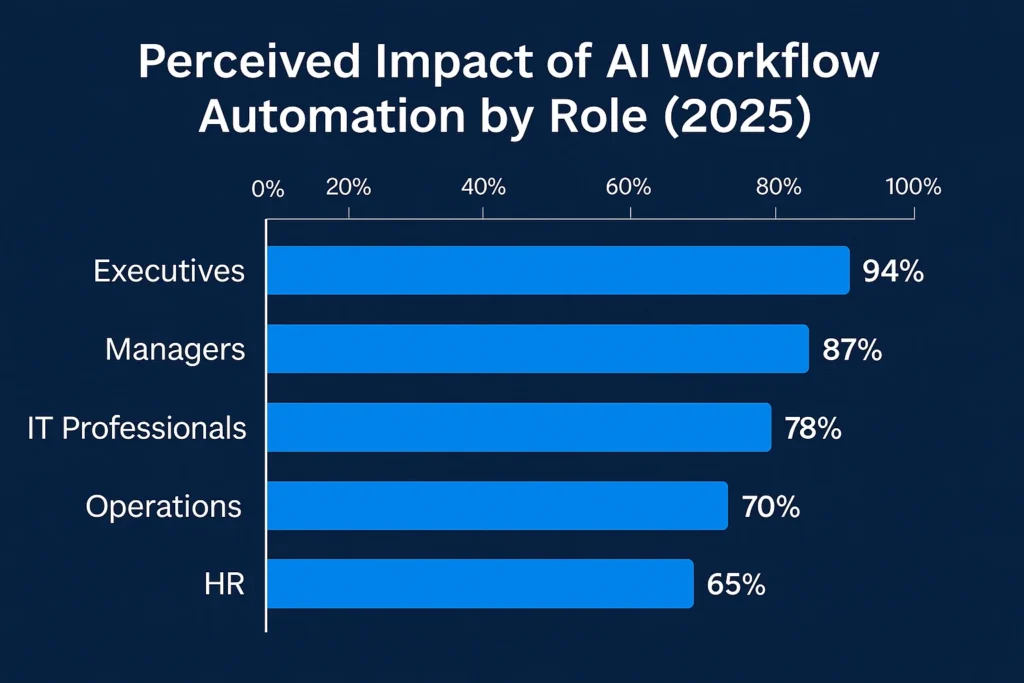
Tactical Benefits by Role
| Role | Value from AI Workflow Automation |
| Project Manager | Real-time dashboards, delay prediction, team capacity alerts |
| Ops Lead | Automated inventory control, performance analytics |
| Support Agent | Suggested replies, automatic categorization, escalations |
| HR Manager | Resume filtering, candidate scheduling, onboarding workflows |
| Sales | Lead prioritization, follow-up triggers, email generation |
Challenges (Deeper View)
- Data Silos
AI needs access to cross-platform data — integration can be a hurdle with outdated systems. - Explainability (XAI)
AI’s decisions must be auditable and explainable — crucial in regulated industries. - Skill Gaps
Many teams lack experience in managing, testing, and optimizing AI workflows. - Workflow Over-optimization
Excessive reliance on AI can remove necessary human checks or creativity.
Human-in-the-Loop (HITL): A Necessary Middle Ground
Even in 2025, full autonomy isn’t always desirable. Many industries are adopting hybrid models:
- AI does 80% of the task
- Human validates or fine-tunes it before execution
- Feedback from human action improves AI model
Think of it like this: AI is the co-pilot, not the autopilot.
What the Future Holds
In the next 2–3 years, we can expect:
- Auto-generated workflows from goal-based prompts
- Autonomous bots that negotiate with one another for task ownership
- Emotion-aware automation that responds to mood and urgency
Cross-company AI orchestration for joint ventures and integrations.